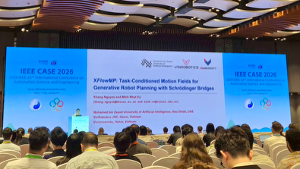
Khang Nguyen and co-author Minh Nhat Vu received the CASE 2026 Best Conference Paper Award for XFlowMP, a framework that learns from demonstrated motions to generate robot movements conditioned on their starting and destination configurations in static environments, such as households and factory settings.
The research addresses how robots can learn to produce physically feasible movements while accounting for their velocity and acceleration.
We spoke with Nguyen, a Ph.D. student in Robotics at Mohamed bin Zayed University of Artificial Intelligence, under Professor Dezhen Song’s supervision, about the project’s origins, its mathematical foundations, and how this research could inform robots that harvest delicate fruit.
Q: Congratulations to you and your team on winning the award. Before we get into the paper, could you tell readers a little about yourself and what first attracted you to robotics?
Khang Nguyen: My journey was not directly into robotics. I studied computer science at the University of Texas at Arlington, under Professor Manfred Huber, where I firstly became interested in mobile computing. After which, I would love to gain more hands-on experience alongside my computer science courses, so I started exploring hardware and systems. That eventually brought me to robotics.
Personally, I love to see tangible research and engineering outcomes. I am fascinated to see something run not only on a computer but also in the real world.
After completing my undergraduate studies, I worked as a junior research scientist at VinRobotics JSC, a humanoid robotics startup in Vietnam. That was where I became interested in motion planning. It covers many different platforms, including manipulators, wheeled robots, humanoids, and legged robots.
I am now a Ph.D. student at MBZUAI, continuing in that direction, with a particular interest in contact localization and manipulation planning with vision and tactile perception for high-valued crop harvesting. Indeed, my background is in computer science, but I enjoy using mathematics in my work. It is essential to robotics.

Q: A robot may have several ways to reach the same object. What makes one movement better than another, and why is choosing a good movement still difficult?
Khang Nguyen: There are many traditional and generative motion-planning methods that work very well. Some work better than ours in particular cases and under particular assumptions. However, our focus is on generating physically feasible movements for a robot in a fixed environment, like in households or in factories.
Imagine a robot operating in a kitchen. It knows where the table is, where the obstacles are, and where it has free space to move. If you ask it to hand you the salt, it must locate the salt and plan a trajectory to reach it with dynamics feasibility.
Doing that repeatedly can be time-consuming. We wondered how we could embed knowledge of those movements into a model that could run quickly on a GPU, so the robot would not need to work through every step out again each time. Just roll out the motion, then execute.
You can think of it as a good habit. In a familiar environment, the robot has learned how to perform certain movements, like human minds after they have a “cognitive” map of surroundings. That was the core motivation behind our work.
Q: What was the central insight behind XFlowMP, and how did it develop from your earlier FlowMP research?
Khang Nguyen: First, let’s give a brief overview of this stream, starting from our foundational work-FlowMP. FlowMP learns more than the path of a movement. When you control a robot, you also have to consider how it follows that path. You might use torque control or velocity control. In our case, we use velocity control.
That means learning the velocity of the movement as well as its path. FlowMP also learns the acceleration profile, which helps keep the movement smooth and stable.
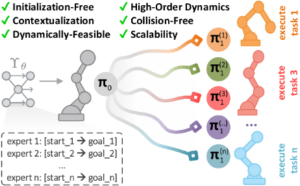
After completing that work, we returned to the question of how the same approach could handle different tasks. That is where the “X” comes in. We use it to universally represent the condition supplied to the model.
Here, the task is defined by the starting and ending configurations, within the workspace where the robot operates. We condition the generation on that information so the model can produce different movements for different tasks.
The central idea is to generate diverse, physically feasible motions under controlled conditions, first in simulation and then on a real robot.
Q: Your demonstration uses a Kinova arm and a LEGO block on a shelf. Could you walk us through how that works?
Khang Nguyen: My co-author, Minh, and I thought about how to demonstrate task conditioning effectively on the robot, which is yet another fun part of the project.
We used a fixed shelf and defined several starting positions, which you can think of as A, B, and C, and several destination positions, D, E, and F. We trained the model on movements between those positions, with each movement associated with its starting and ending configuration.
The camera provides information about the block’s position. If the task is to move between B and E, for example, that position information conditions the model, and it generates the corresponding movement based on the data it has learned from.
The same principle applies to other pairs, such as A to F or C to F. It is a straightforward way to show what conditioning does: you know where things are and where they need to be, and the model generates a movement for that task.
Q: The title refers to a “Schrödinger bridge.” What is that, and what does it do in XFlowMP?
Khang Nguyen: When people hear Schrödinger, they often think of the famous cat example. In our case, the simplest way to describe the bridge is as a mathematical tool for transforming a distribution of random noise into a distribution of trajectories.
The model receives a condition, such as the starting and ending configurations, and gradually transforms the noise into candidate trajectories associated with that condition.
It is related to generative methods, such as diffusion and flow matching, although the mathematical backgrounds are different from each other. The Schrödinger bridge uses a reference stochastic process, which gives us a particular way to learn that transformation.
In our work, we combine it with a learned score function that helps guide the generation according to the task. It is an optimal transport technique that we use as a tool for generating robot motions.
Q: What can the system adapt to, and what would require further training?
Khang Nguyen: The starting and ending configurations provide the task condition. If that condition changes, the generated path, velocity, and acceleration should change accordingly.
But a fixed environment is an important assumption in our work. The robot has learned movements in that environment and knows where the obstacles are through that training. For a new environment, the model would need further fine-tuning.
We do not currently have perception operating throughout the movement to respond to an unexpected obstacle. If a hand suddenly appears and blocks the robot, our model cannot adapt to that on the fly. We use the initial perception information to generate the movement.
We have also tried reactive control: if the end effector is displaced from its planned trajectory, how can it return to that trajectory and continue? We have not yet been very successful with that, but it is a direction we would like to pursue.
Q: Can collision avoidance be learned from examples, and what other limitations would you highlight?
Khang Nguyen: It can be learned from examples, but that would require a lot of augmented data. You may be able to learn a particular path from very few demonstrations. Along that path, however, there are many possible situations in which a collision could occur.
That suggests combining the data-driven, generative approach with model-based control. We want to keep the benefits of learning from demonstrations while introducing methods that can respond to obstacles.
Another limitation is that our demonstration uses one manipulator and one gripper. Humans often use two hands together, and robots performing assembly may also need coordinated movements. We have not yet extended this work to bimanual or multiple-arm operation.
We also consider rigid objects. In agriculture, we deal with delicate, deformable objects such as peaches, tomatoes, and strawberries. Handling those introduces challenges beyond reaching a position. When picking fruit, for example, you need to apply enough force to detach it from the stem. That brings force control into the problem as well.
Q: Which experimental result were you most pleased with, and why?
Khang Nguyen: The result that pleased us most was the task conditioning. We wanted the model to distinguish between tasks and generate the appropriate movement for each one. We call this its contextualization ability.
As a simple analogy, if you ask someone to draw a cat, they draw a cat. If you ask for a rabbit, they draw a rabbit. They should not confuse the two requests. Similarly, we want the generated motion to correspond to the task supplied to the model.
That is the essential result we wanted to demonstrate: the conditioning works, and the model can distinguish different trajectories.
This comes from how we combine the score function with the Schrödinger bridge formulation. It is the result of deliberately modelling how the task condition guides generation.
Q: What comes next, and where do you see opportunities for practical use?
Khang Nguyen: There are opportunities to take these ideas into other areas, including vision-language-action models and world action models. Learning how movements can be controlled, including their velocity and acceleration, could provide useful insights for that research.
For me personally, the focus over the next four or five years of my Ph.D. will be agriculture. FlowMP and XFlowMP have given me ideas about how robots might learn to reach and pick fruit at different positions.
We are interested in greenhouse settings, where there are structured lanes for robots and people to move between the crops. The robot could be used for monitoring, picking, and other tasks.
Even in that structured setting, fruit grows in different positions and can be hidden by leaves or other fruit. If two fruits are close together, which should the robot pick first? Could it use one hand to move leaves aside and the other to pick the fruit?
Farmers do these things very naturally. How can we learn from them and enable robots to work in a similar way? From my end, that is a major motivation for taking this research into the agricultural domain!
Play