The EU considers a power-through-numbers coordinated robotics strategy.
Many cooks in the Robo-kitchen
In September 2026 at a showcase in the European Parliament, kitchen robots built by French, German, and Portuguese teams worked together to clear a table and load a dishwasher. They moved slowly and deliberately, providing a safety margin when operating near people (1). This demonstration was a fitting metaphor for European robotics itself: it highlighted precision engineering, human-centeredness, and cross-border research, while also reflecting how European robotics may need to pick up the pace of development as global competition intensifies (2).
Europe has a long history of imagining robots, from Leonardo da Vinci’s Robotic Knight of the 1490s to Jacques de Vaucanson’s automaton flute player of 1737 (3). It also has a long tradition of grappling with the ethics of robotics (4), reaching back to Karel Čapek’s 1920 philosophical play “R.U.R.” that first coined the word ‘robot’ (5). The pioneering legacy of European robotics continues today (6), if more quietly than in the headline-grabbing robotics sectors of China and the U.S. Europe gave rise to global industrial leaders like KUKA and Universal Robots. European research institutions rank in the top 10 globally for robotics output (7); in fact, Europe is on par with the U.S. for total output of robotics publications, and consistently generates higher citations per research article compared to their Chinese counterparts (8).
This article examines the roadmaps and strategies guiding robotics within the European Union (EU): 27 member states that share a single market and common institutions, but largely run their own innovation systems. The EU faces pressure from several directions to accelerate robotics advancements. Externally, the war in Ukraine has elevated autonomous tech like drones to an urgent security priority (9). Meanwhile, an escalating U.S.–China tech rivalry encourages the EU to push tech sovereignty to the top of their own economic and political agenda (10) (which is further motivated by the uncertain relationship with Washington (11) – recently exemplified by the addition of foreign advanced robotic systems into the U.S. ‘Covered List’ (12)). Demographically, aging workforces are increasing demand for automation (13), along with escalating tensions around immigration and labor shortage (14). Internally, regulatory fragmentation hobble the scaling efforts of enterprises (15), while venture capital and research funding remain unevenly concentrated in a handful of wealthier countries (16). Member states rank these priorities differently based on geographic exposure, economic structures, and domestic political climates.
Brussels’ Levers of Funding and Networking
Positioned at the center of security, regional, and economic tensions, EU policymakers in Brussels have been debating a coordinated EU-level robotics strategy in recent years (17) – a move that could harmonize otherwise fragmented national efforts, while risking over-regulating a field that demands agility. To further explore the implications of an EU-wide robotics strategy, we first look at the existing EU systems in place for supporting robotics development.
The European Commission’s current approach to robotics has a clear division of labor; Brussels funds early-stage robotics research and sets regulations, relying on networks and associations to develop strategies from the bottom-up. Meanwhile, scaling and deployment are left largely to member states.
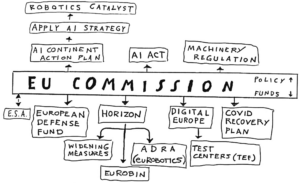
The largest EU research budgets that touch robotics come from defense (18), with roughly $8.3 billion from the European Defense Fund (2021-2027) available to finance cross-border consortia on areas including AI and robotics platforms (19). In parallel, the European Space Agency (ESA) (comprising of both EU and non-EU members) secured approximately $3.4 billion for 2026–2028 toward human and robotic space exploration (20).
Another primary vehicle for civilian and industrial robotics R&D is the EU Horizon Framework Program, which dates back to the 1980s (21, 22). Its current edition, Horizon Europe (2021–2027), has a budget of about $107 billion. An estimated $183 million from this budget was allocated directly for robotic advancements between 2023-2025, supporting works related to space (23), agriculture (24), construction (25), and photovoltaics (26). And while not explicit in funding calls, robotics development additionally taps into Horizon budgets allocated for other relevant fields, such as healthcare and AI (27, 28).
Through Horizon Europe, the European Commission has also funded a family of AI & robotics Networks of Excellence (29). Together, these networks have supported thousands of academic papers, fostered joint curricula, and accelerated tech startups. The network dedicated to robotics, euROBIN, links 31 core partners from 14 countries (30). Its tools include EuroCORE, a shared repository for code and datasets, and robot “coopetitions,” in which international teams are scored on the interoperability of their software with competitor’s hardware (31, 32). In early 2025, euROBIN also published the EU Robotics Strategic Agenda, calling for a unified EU policy on embodied AI, before concluding its initial Horizon funding cycle in late 2026. The aforementioned robotic kitchen demonstration in Parliament was part of euROBIN’s closing event, where members called for an ambitious EU-level initiative for scaling and adopting home-grown robotics, analogous in scale to the European Chips Act (33, 34).
Horizon funding also flows into public-private partnerships, most notably the AI, Data and Robotics Partnership. Its private-side member, the AI, Data and Robotics Association (ADRA), brings together companies, research institutes, and startups across the three fields. ADRA publishes joint roadmaps like the Strategic Research, Innovation, and Deployment Agenda (SRIDA) (35, 36) which highlights European priorities and shapes future Horizon calls. ADRA’s robotics co-founder, euRobotics, is an association of industrial and academic members that advise the European Commission, regularly issuing calls to action like the 2026 Vienna Statement, calling for the EU to set its own robotics-specific agenda (37).
Horizon Europe funding extends beyond the EU borders through “association” of non-EU countries. By paying membership fees into the EU budget (and committing to a rules-based market economy and democratic principles), researchers from outside the EU are granted the ability to apply for and lead projects largely on the same terms as EU researchers. Countries become associated through different legal routes, examples including Switzerland regaining Horizon access through the 2025 EU Programs Agreement (EUPA) (38), the UK through a protocol under the Trade and Cooperation Agreement (TCA) (39), Norway and Liechtenstein through the European Economic Area agreement (EEA) (40), and even distant countries like Japan and South Korea through dedicated Strategic Partnership Agreements (SPA) (41, 42, 43). For fields like robotics, association enlarges the pool of funding and expertise behind expensive joint projects, and keeps research ties open with like-minded partners in an era of heightened geopolitical uncertainty (44).
Spreading Robotics Capabilities through Horizon Widening Measures
A persistent structural issue in European innovation is geographical concentration of research capital. Historically, most Horizon funding has flowed to universities and institutions in Western and Northern Europe. To narrow this “innovation divide,” the Horizon Europe reserves part of its budget for “Widening Participation and Spreading Excellence.” These instruments are open only to institutions in lower-R&D-intensity countries, mostly in Central, Eastern, and Southern Europe (45). In robotics, the main widening instrument is the Teaming for Excellence scheme (46), which pairs a leading institution from elsewhere in the EU with one in a widening country to build a new center of excellence. The clearest example is HERON, Greece’s first robotics center of excellence. Launched in April 2025, HERON is led by the Athena Research Center with the Italian Institute of Technology (IIT) and Germany’s Karlsruhe Institute of Technology (KIT) (47). HERON’s long-term funding of about $39 million combines Horizon money with Greek national and private contributions, and intends to focus on safety and security, field robotics, healthcare and social robotics, and makerspaces. Such widening measures have the capability to build research capacity across the EU. But like other Horizon projects, these measures leave the capital-intensive work of commercial scaling and industrial deployment within the jurisdiction of individual countries.
Brussels’ Regulatory Levers
In addition to funding allocation, the second main lever used by the EU to shape the robotics landscape is regulation. The EU is known to champion comprehensive regulations for technology that in many cases have set global standards (a phenomenon colloquially known as the “Brussel Effect”), such as for data privacy, vehicle emission, hazardous substances, and more recently, AI. And while robotics traditionally has fallen into the physical machinery regulations (48), its increasing convergence with AI make it subject to the EU AI Act (49), the first comprehensive cross-sector AI law that entered into force in August 2024. Consistent with EU data protection laws (50), the AI Act prioritizes user privacy ahead of rapid rollout. The AI Act is structured in an anticipatory risk-tiered system – high-risk systems having to adhere to strict requirements, including regular self-risk assessments, traceability, and human oversight. Many European tech companies acknowledge these proactive rules set a responsible global standard for ensuring user privacy, transparency, and public trust (51). A recurring criticism is that the regulations may be over-anticipatory and may push European companies toward jurisdictions with lighter, more market-driven rules (52).
In addition to passing the 2026 EU Digital Omnibus which helps to delay high-risk obligations and streamlines regulations for systems with overlapping regulations like robots (53), the European Commission has implemented support for robotic innovations within the AI Act’s regulatory framework through their 2025 release of the Apply AI Strategy (54). This AI dissemination strategy, part of the larger AI Continent Action Plan, is allocated around $1 billion through existing Horizon calls, and mentions the “European Robotics Catalyst” initiative (55, 56) for implementing AI-driven robotics into high-impact use cases. The Robotics Catalyst, tasked to ADRA for coordination, does not yet have a dedicated budget, however – and as a smaller sub-topic within the Strategy, it is still unclear whether it will equate to the larger EU-led robotics strategy that was envisioned and discussed the year prior (17). It would seem that the strategy for robotics deployment remains largely within the jurisdiction of the individual EU nations.
Summary of major EU funding and policy schemes influencing robotics advancements.
Country Spotlights
A variety of EU member states have plans for incoming robotics developments that are worth examining (57, 58, 59). For brevity, here we highlight five of those countries whose strategies differ in instructive ways: Germany, Italy, France, Sweden, and Poland.
Germany
Eurovision results aside (60), Germany remains the EU’s economic champion and industrial engine. Germany ranks fifth in the world for their industrial robotic installations behind China, Japan, the U.S., and South Korea (61), and is internationally recognized for its manufacturing expertise of high-precision components and high industrial standards (62). That success has also made German firms attractive acquisition targets, making them subject to increasing foreign trade pressures — embodied by the landmark 2016 acquisition of industrial giant KUKA by China’s Midea Group. Technological sovereignty is viewed increasingly as a necessary pillar of German economic and national security strategy (63).
Germany has a long record of publishing government-led technology strategies, indicating sustained political commitment towards a modernized tech landscape. Their 2011 unveiling of Industry 4.0, under the High-Tech Strategy, paved way for the digitization and bolstering of the automated manufacturing industry – a concept that took root globally, even eventually inspiring China’s strategy, Made in China 2025 (64).
The current framework, 2025 High-Tech Agenda Deutschland (HTAD), prioritizes 6 key technologies including AI, with a major goal being to use AI to generate ten percent of German economic output by 2030 (65). Robotics is baked into this AI pillar of the HTAD as one of its flagship measures, the AI Robotics Booster. The Booster is granted approximately $114 million over five years, and split into three parts: 1) the establishment of Robo-Hubs, sector-specific testing facilities across Germany for bridging robotic research into industry applications (66), and 2) greater investment into disruptive innovation in robotics – specifically in multi-purpose AI-based robots – which will be executed through the Germany Federal Agency SPRIN-D, which runs challenges similar to the US DARPA program (67).
Germany’s main coordinating body for these robotics efforts predates the HTAD. In November 2023, the Federal Ministry of Research, Technology and Space (BMFTR) (prior the federal research ministry) published its Robotics Research Action Plan (68). The plan’s centerpiece is the Robotics Institute of Germany (RIG), a decentralized network launched in July 2024 with up to $23 million over four years. RIG links 16 leading robotics research centers, including Fraunhofer institutes, the Max Planck Institute for Intelligent Systems, and the German Aerospace Center (DLR), and the German Research Center for Artificial Intelligence (DFKI), while nineteen associated partners comprising of universities and academic networks complement its core. RIG coordinates joint research, shared infrastructure, talent programs, and start-up support, and organizes the annual German Robotics Conference (69) – along with holding advisory responsibilities for the AI Robotics Booster plan.
Regional ecosystems add to this federal layer. The best known is Cyber Valley in the Stuttgart–Tübingen region, one of Europe’s largest AI research partnerships which serves as a hub for robotics, AI and machine learning. It was founded in 2016 by the state of Baden-Württemberg, the Max Planck Society, two universities, and industrial partners including Bosch, BMW, and Porsche (70). Since 2022, its Tübingen AI Center has received permanent federal and state funding of about $22 million a year (71).
While the European Commission relies on multiple networks and organizations to coordinate robotics research agendas, Germany includes all robotics efforts under one ministry, the BMFTR – from a national research network (RIG), to transfer hubs to upscaling support under SPRIN-D – which are all monitored under a dedicated budget in the Booster Plan. The budget is modest: roughly $23 million a year, amounting to the same amount received by the aforementioned Tübingen AI Center. Germany has the structure for a strong national robotics strategy, and whether it has the funding to match its ambitions remains to be seen. This financing struggle comes at a time where U.S.’s Nvidia has recently committed major investments into German AI and robotics companies (72) – further stoking debates over whether the benefits of foreign support and partnership outweigh the risk of technological dependency (73).
Sweden
Sweden has a history with robotics dating back to the late 1960s, when they were the first European adopters of all-electric robots for factory pick-and-place tasks, a few years later inventing the first commercially available microprocessor-controlled robot (74). And with a combination of strong working unions and high reported quality of life, within the EU the Swedish public has consistent positive attitudes (representing around 80% of the public) towards robotics and automation in their workplaces, and is ranked as the second highest robotics adopter in the EU after Germany (75, 76).
Sweden has prominent industrial robotics stemming from their country, one notable firm being the automation company ABB (though their robotics division, like Germany’s KUKA, was divested to foreign companies in 2025 (77)), and Husqvarna, the company that globally popularized robotic lawnmowers. Sweden is also a major player in automated mining systems; Epiroc and Sandvik are two globally leading companies that develop autonomous underground drill rigs and haulers for mining in otherwise hazardous environments. And with these industry’s close partnership with LKAB, the Swedish firm responsible for mining 80% of the iron ore within the EU (78), Swedish robotics may play a role in securing a resilient supply chain for further robotics development in the EU (79, 80).
Perhaps owing to large public trust and enthusiasm for robotics and automation advancements, another key driver of robotics innovation in Sweden comes from a single private philanthropy; in 2015 the Knut and Alice Wallenberg Foundation established the Wallenberg AI, Autonomous Systems and Software Program (WASP) (81). WASP both funds research collaborations across a network of 6 Swedish universities and 80 local companies, secures international collaborations with prominent universities, and has developed a specialized WASP graduate school for autonomous systems (82). No government-led robotics strategy exists for Sweden; its reliance on local foundation in addition to industry-led robotics, while risking private exits feeding foreign competitors, has ensured consistent funding flow even amidst moments of economic turbulence like the COVID pandemic (83, 84).
Italy
Italy’s prominent automation success story was also never written into a government plan. Along the old Roman road of Via Emilia, a century of spin-offs stemming from a single machine-maker has produced “Packaging Valley,” a cluster that today exports over $9 billion a year of intelligent machinery that fill, wrap, and box much of the world’s food and medicine (85). Perhaps not coincidentally, Italy sits at fourth place among the global industrial robot exporters and ranked second within the EU just after Germany (86).
While Italian robotics is not driven by quantifiable metrics, Italy does have a forward-looking robotics roadmap as a part of the National Research Program (PNR 2021–2027) published by the Ministry of University and Research (MUR) in late 2020 (87). As the country with the oldest demographic in Europe (second to Japan globally (88)) and the second highest in national debt (89), societal ageing and economic productivity are especially urgent issues for Italy – both issues which robotics and automation have the potential for alleviating. To this end, the robotics roadmap highlights specific sectors which could benefit the most from robotics, such as in healthcare, environmental and infrastructure monitoring, and intelligent automation.
Following the COVID pandemic, Italy became among the largest beneficiaries of the EU’s COVID recovery package – amounting to over $80 billion in grants and $137 billion in loans – which ultimately formed the backbone of Italy’s National Recovery and Resilience Plan (PNRR) (90). PNRR funds were allotted by the EU in annual installments upon the condition that the funds are partially used to invest into digitalization, intelligent systems, and renewable energy. This PNRR became a crucial funding source for investing into Italian robotic research and robotics adoption.
The PNRR was invested into robotics in a couple of ways. On the research front, it funded the Robotics and AI for Socio-economic Empowerment (RAISE) (91) – a robotics and AI ecosystem led by the University of Genoa, the Italian Institute of Technology (IIT) and the National Research Council of Italy (CNR). It also funded the economic strategy “Transition 5.0 for Italy”, which focused on robotic adoption at the commercial level with the main objective of reducing commercial energy consumption. One of the decisions was the introduction of a tax credit of up to 50% for Italian companies willing to adopt robotics, among other smart technologies, into their workplace (92). While the investment into RAISE strengthened local robotic partnerships between research labs and industry (93), on the adoption side, the Transition 5.0 incentives produced a stop-and-start cycle in industrial automation investments rather than steady growth (94). A delay in the execution of Transition 5.0 may have impacted this result – as it was announced in late 2023 but only became usable a year later. Firms held back robotic purchases in the meantime, and consequently, domestic deliveries of robots fell almost 16% in 2024 (95) – nearly 40% when considering all machine tools, robots and automation (96). Demand revived after the tax rules were simplified, but remained well below its 2022 peak (97), and annual robot installations fell in both 2024 and 2025 (98).
With the PNRR’s final payment due by the end of 2026, Italy is shifting to utilizing national funding once more, introducing a hyper-depreciation scheme that replaced Transition 5.0 to continue incentivizing commercial adoption of robots (99). And while leading Italian robotics institutes like IIT are entitled to annual national funds (100), it would seem that EU-wide sources like Horizon funds will continue to propel Italian robotics advancements.
Poland
Poland has the largest robotics market in central and eastern Europe, and saw a nearly 12% increase in robotic installations (outside of automotive) between 2024 and 2025 – staggering amidst a backdrop where the average installation rates in Europe dropped by nearly 10% (101). The rise of robotics in Poland is not met with the same optimism of Sweden, however; the Polish community remains largely apprehensive of robotics and AI, even hosting the first humanoid-led protest in Warsaw this past September (102) calling for governmental protection against widespread job displacement – a potential risk as 7.3 million jobs in Poland were recently deemed automatable in a McKinsey report (103).
At the same time, Poland’s strategic position along the EU and NATO eastern border with Ukraine and Belarus has made robotics and autonomous systems relevant for national defense and border security. While no direct robotics roadmap or national strategy exists in Poland, the Polish government has combined military procurement for ‘smart’ border surveillance and anti-drone interceptors (104) with industrial modernization initiatives like the East Shield program (105). In addition, universities such as Military University of Technology and Wrocław University of Science and Technology are involved in 11 among 57 of the research projects supported by the European Defense Fund for this year for developing defense technologies including unmanned systems (106).
Beyond national security initiatives, the Polish government introduced a dedicated tax relief that allows companies to deduct 150% of prior eligible costs associated with purchasing industrial robots, sensors, and training (107). While automation tax incentives exist in countries like Italy, Poland’s tax break specifically targets robotics for spurring innovative manufacturing practices.
France
France employed a heavy top-down government-led strategy to advance robotics, with the main objective to usher in a “Made in France” technologically sovereign ecosystem.
The largest government-led robotics strategy is nestled within France’s national investment plan, France 2030 (2021-2030), an environmentally sustainable-focused funding package of $54 billion that would be equally allocated towards two objectives: 1) decarbonizing of the economy, and 2) driving innovation with reduced ecological footprints. Robotics and intelligent automation fall within the second objective as a method to improve task efficiency. As such, within France 2030 lies a dedicated robotics strategy, Robotics and Intelligent Machines, which aims to advance industrial robotics, drones, and additive manufacturing (108), with a total budget of nearly $900 million. This funding is channeled into robotics efforts namely led by two research programs: Priority Research Program and Equipment in Robotics programs (PEPRs) led by the French National Center of Scientific Research (CNRS) ($33 million spread across 6 years)(109) as well as calls for proposals by the CNRS’s industrial counterpart, Bpifrance (110). By focusing projects around energy-frugal compute and specialized field robotics, France aims to secure a defensible niche in sustainable automation.
As part of France 2030, France’s federal tech-advancement agency, Mission French Tech, also channels state support to robotics startups through the cross-sector French Tech 2030 program (111). 15% of the 80 funded companies represent robotics, alongside quantum and semiconductor ventures – reflecting the growing national prioritization of robotics.
In a stark contrast to the robotics developments included in their sustainability-oriented national strategy, France’s outward display of military robotics carries outsized symbolic weight in their robotics scene. The annual global military expo held in France, Eurosatory, this year showcased 2,600 exhibitors highlighting technologies like autonomous drones and anti-drone technologies (112). As the host, France made up a third of the exhibitors (with Germany coming in second) (113), and French army officials made press releases during this time stating their intention for utilizing armed robots by 2028 (114). The Minister of Industry and the Secretary-General for France 2030 announced 31 new winners of the call “Offer of excellent robots and intelligent machines” at Eurosatory (115) – and while many of the winners were pitched as civilian technologies, the backdrop and context of the release ties the call to rising dual-use technologies, with civilian uses (industry, logistics, energy, agriculture) alongside growing defense and homeland-security needs.
An EU robotics strategy would have to perform a careful balancing act to satisfy its 27 member states, each with unique geographic needs, economic structures, and domestic political climates.
An EU Strategy – Too Many Cooks, or the More the Merrier?
The example countries highlighted above represent just a handful of the 27 members of the EU, each of which display unique motivations and strategies for driving robotics innovations. This prompts the question: does it make sense for the EU as a body to have a coordinated robotics strategy? A move for such a coordinated effort has been anticipated since 2024 (17), and remains an active point of discussion, as highlighted at the recent strategic debate within the European Parliament (116).
At the EU level, a coordinated strategy can take different forms. In one scenario, a coordinated strategy can drive member states together towards a quantifiable goal, where each nation plays to its strengths as a spoke in a larger machine. Resources can be pooled together by member states to enable scalability of innovations that are otherwise too resource-intensive or financially risky for one country alone. An example of this strategy is in the creation of the European Airbus (117). In a time where the aviation industry was dominated by American enterprises like Boeing and Lockheed, individual European countries that otherwise possessed aviation technologies were unable to scale into enterprises due to the risks associated with financing such large project. Eventually a consortium of countries including France, Germany, and later Spain and the UK, banded together to finance European aviation efforts. Economic and political interests of each country were appeased by handing each a responsibility over a component of the production process, ensuring employment and economic activity for each. Separate collective bargaining agreements were made across each country, along with the creation of joint stakes in equity shareholding to enable share economic gains across involved countries (118). Airbus ultimately became Boeing’s largest global competitor, and is widely considered an EU success story.
An EU-wide robotics strategy could in principle take advantage of regional expertise in the various specialized components necessary for full-stack robot deployment; one integrated sovereign stack leveraging countries specializing in topics like AI, batteries and quantum computing, chip design, precision hardware, and critical mineral processing. Members of the EU excel particularly in the topics of embodied intelligence, human-robot interaction, and multi-robot coordination (119), all of which could fulfill niche roles within a larger applied collaboration. At the same time, the Airbus example from above may not be the fairest comparison to a comprehensive EU robotics strategy, especially for soft-ware defined spaces like AI; digital markets undergo changes more rapidly compared to the slower-moving and iterative aircraft manufacturing industry, making it harder to coordinate among 27 nations while advancing at a competitive speed. In addition, the Airbus model cost decades of planning along with large government subsidies (which have raised past international scorn), before the project was consistently profiting (120). Such slow profit schemes may not hold up to the competition of international robotics innovators.
Another (perhaps parallel) path for an EU-led coordinated robotics strategy is for the EU to actively encourage its member states to develop concrete robotics roadmaps and strategies, and serve a primary role as a facilitator of emerging inter-European innovation networks. The European Commission could also function as an observation deck for monitoring the status and progress of various robotics developments – essentially a scaled-up EU-version of Germany’s RIG program. Individual nations can manage their own strategic mechanisms for maintaining maximum agility and rapid transfer of their native robotic innovations. The facilitation approach is also the method so far taken for EU-led strategies like the AI Continent Action Plan (121) – a plan which strives for AI sovereignty through the development of gigafactories, platforms for incentivizing private investments, the creation of Skills Academies, as well as the creation of a digital Service Desk that helps Europeans streamline and expedite their AI development efforts.
Europe’s robotics ecosystem stands at a crossroads. Its foundational research, talent pool, and engineering quality remain top-tier, yet its commercial impact is frequently muted by fragmented markets and a complex regulatory framework. Like the collaborative kitchen robots demonstrated in Parliament, Europe’s current strength lies in precision, safety, human-centeredness, and cross-border cooperation. However, when operating in a global arena alongside fast-moving competitors, speed matters. Whether Brussels chooses to orchestrate a centralized industrial push modeled on Airbus or refine its role as a network facilitator, it is responsible for a framework supporting both ethical standards and speed.
Next stop, we will be visiting Mexico and its local state-led robotic strategies. Stay tuned!
Ellen H. Rumley – Policy Analyst
Allison Okamura – Vice President
IEEE RAS Science & Technology Watch Board