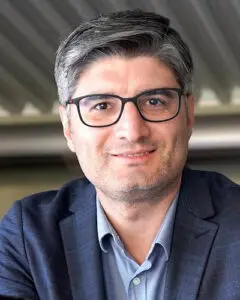
BIOGRAPHY
I am a Full Professor at Paderborn University, Germany, in the Department of Electrical Engineering and Information Technology, since April 2023. Previously, I was an Associate Professor at Aarhus University, Denmark (2018–2023), and an Assistant Professor at Nanyang Technological University, Singapore (2014–2018). I began my academic career as a Post-doctoral Researcher at Katholieke Universiteit Leuven, Belgium (2011–2014). I have eight graduated and eight on-going PhD students. I have extensive experience in interdisciplinary research, fostering collaboration across mechatronics, mechanical, electrical, and computer engineering. My work in control theory for robotics, machine learning, and artificial intelligence has been internationally recognized, significantly impacting computational intelligence and robotics communities.
IEEE ACTIVITIES
COMMITTEES/BOARDS:
- CIS Conferences Strategic Planning Subcommittee, April-December 2024.
REGIONS: Region 8
SECTIONS/CHAPTERS:
- Jan 2016 – Apr 2018 IEEE Singapore Computational Intelligence Society Chapter Committee
- Jan 2015 – Jan 2016 IEEE Singapore Section Executive Committee Member
STUDENT BRANCHES:
SOCIETY:
- JAN 2005 – PRESENT IEEE Member (Senior Member since March 2012)
- JAN 2015 – PRESENT IEEE Computational Intelligence Society Member
- JAN 2017 – PRESENT IEEE Robotics and Automation Society Member
CONFERENCES:
- General Chair 2025 IEEE Symposium Series on Computational Intelligence, Trondheim, Norway. 17th-20th Mar 2025 held from March 17 to 20, 2025
- Workshop Organizer IROS 2022 – 2022 IEEE/RSJ International Conference on Intelligent Robots and Systems, Kyoto, Japan, October 23–27, 2022| Open and Trustworthy Deep Learning for Robotics
- by Erdal Kayacan, Robert Babuska, Jens Kober, Abhinav Valada, Alexandros Iosifidis, and Nikolaos Passalis.
- General Chair 2nd International Conference on Robotics, Computer Vision and Intelligent Systems (ROBOVIS 2021), held online from October 27 to 28, 2021
- Workshop Organizer IROS 2021 – 2021 IEEE/RSJ International Conference on Intelligent Robots and Systems, Prague, Czech Republic, Sept 27-Oct 1st, 2021| Reliable AI for Marine Robotics: Challenges and Opportunities by Erdal Kayacan, Einar Broch Johnsen, João Borges de Sousa, and Bilal Wehbe.
- Editor ICRA 2025 – 2025 2025 IEEE International Conference on Robotics & Automation, 19–23 May, Atlanta, USA,
- Associate Editor IROS 2025 – The 2025 IEEE/RSJ International Conference on Intelligent Robots and Systems (IROS 2025, October 19 to 25, 2025 in Hangzhou, China.
- Associate Editor IROS 2021 – 2021 IEEE/RSJ International Conference on Intelligent Robots and Systems, Prague, Czech Republic, Sept 27-Oct 1st, 2021
- Associate Editor IROS 2019 – 2019 IEEE/RSJ International Conference on Intelligent Robots and Systems, The Venetian Macao, Macau, China, 3-8 November 2019.
- Associate Editor IROS 2018 – 2018 IEEE/RSJ International Conference on Intelligent Robots and Systems, Madrid, Spain, 1-5 October 2018.
- Tutorial Organizer FUZZ IEEE 2017 – IEEE International Conference on Fuzzy Systems, Naples, Italy, 9-12 July 2017| Vision-Based Control of UAVs Using Type-1 and Type-2 FLCs with ROS by Erdal Kayacan and Changhong Fu
- Special Session Organizer FUZZ IEEE 2017 – IEEE International Conference on Fuzzy Systems, Naples, Italy, 9-12 July 2017| Type-1 and type-2 neuro fuzzy systems: quo vadis? by Erdal Kayacan; Mojtaba A. Khanesar and Mohammad Biglarbegian
- Special Session Organizer FUZZ IEEE 2017 – IEEE International Conference on Fuzzy Systems,Naples, Italy, 9-12 July 2017| Advances to fuzzy logic control by Tufan Kumbasar; Erdal Kayacan and Hao Ying
- Special Session Organizer IEEE TENCON 2016 – Technologis for Smart Nation, Marina Bay Sands, Singapore, 22-25 November 2016| Computational Intelligence Techniques and Applications by Justin Dauwels, Lipo Wang, Erdal Kayacan; Teck Hou Teng
- Special Session Organizer IEEE ASCC 2013 – Asian Control Conference Istanbul, 23-26 June 2013| Complex Mechatronic Systems by Erdal Kayacan, Peter Vrancx and Wouter Saeys
- Special Session Organizer IEEE ASCC 2013 – Asian Control Conference Istanbul, 23-26 June 2013| Fuzzy Logic Systems and Applications by Erdal Kayacan and Mojtaba A. Khanesar
OTHER:
- Sep 2022 – Present Associate Editor, IEEE Robotics and Automation Letters
- Dec 2019 – Present Associate Editor, IEEE Transactions on Mechatronics
- Jan 2017 – Jan 2023 Associate Editor, IEEE Transactions on Fuzzy Systems
QUALIFICATIONS
Chair of the Automatic Control Group at Paderborn University: In this role, I have developed extensive experience in managing administrative and organizational responsibilities, gaining a deep understanding of how to effectively coordinate and streamline complex processes.
Participation in five H2020 EU Projects: Through these projects, I have ensured project efficiency, balanced the needs of multiple stakeholders, and fostered collaboration across diverse teams, all while upholding high standards of professionalism.
Editorial Experience with IEEE Journals: I have gained valuable academic experience through editorial work in several IEEE journals, including IEEE Robotics and Automation Letters, IEEE Transactions on Mechatronics, and IEEE Transactions on Fuzzy Systems. This has also enhanced my understanding of cross-society activities within IEEE.
Editorial Experience with IEEE Conferences: I have served for several years as Editor and Associate Editor for leading conferences such as ICRA and IROS. This long-term involvement has significantly strengthened my expertise in the robotics field.
I am confident that these experiences will be invaluable in the role of AdCom member, where strong leadership, organizational expertise, and a proactive, solutions-driven mindset are essential to advancing the committee’s objectives.
MAJOR ACCOMPLISHMENTS
IEEE Transactions on Mechatronics junior reviewer programme (TJRP): I am the Chair of the TJRP Committee. I have initiated the programme, which is intended to introduce young researchers in the mechatronics research community to the best practices in peer-reviewing of scientific publications under the guidance of Editorial Board members.
POSITION STATEMENT
As an active member of IEEE RAS, I am fully committed to helping our society grow and stay impactful as technology and research continue to evolve. Below are my ideas on how we can address some of the key challenges in the robotics community:
Attracting and Retaining Members: Bringing in and keeping members is crucial for RAS to thrive. To do this, we need to offer valuable professional development opportunities and create more chances for networking through events and conferences. For example, while serving as General Co-Chair for SSCI 2025, I organized a Young Professionals Lunch. This event gave early-career researchers a chance to meet IEEE leaders, share ideas, and learn from their experiences. I will continue to be proactive and creative in planning similar activities to grow our membership.
Encouraging Interdisciplinary Collaboration: Robotics research brings together many fields, including electrical engineering, mechanical engineering, computer science, and more. We should work harder to connect these fields, especially in areas like AI, machine learning, and data science. I believe RAS should co-organize more conferences with other IEEE societies. Strengthening interdisciplinary activities will expand the reach and impact of our work.
Maintaining High-Quality Publications: Protecting the quality and integrity of our publications is critical to keeping RAS respected. We must continue to focus on strong peer review processes. In addition, I suggest creating a few official RAS conference website templates to strengthen the branding of our events.
Addressing Ethical Challenges in New Technologies: RAS must take the lead in promoting ethical standards and building technologies that are fair, transparent, and accountable. We need to help our members think about the social impact of their work. I plan to support efforts to provide resources on ethical guidelines, responsible AI and robotics practices, and to foster a culture of inclusivity and diversity throughout technology development.