SPARX: Support Program to foster Academic Relationships and eXchange

SPECIAL NOTICE – The SPARX site has moved! Please click here for the new location. This particular page will close at the end of 2025.

The IEEE Robotics and Automation Society (RAS) is proud to introduce SPARX, a reimagination of the previous initiative on Development Country Faculty Engagement Program, focused on nurturing academic excellence and research collaboration in the field of Robotics and Automation. SPARX connects faculty members from developing countries and countries at risk with distinguished RAS mentors to elevate their research and publishing efforts in RAS conferences and journals.

SPARX offers a $10,000 funding opportunity for selected mentor-mentee teams, spanning about two years ($5,000 USD per year). This financial support aids collaborative research, conference participation, and project-related expenses. It is intended to empower academic contributions in Robotics and Automation.

IEEE has identified developing countries based on data released by the World Bank. Priority for acceptance to this program will be given to applicants from the countries marked with an asterisk on this page: https://www.ieee.org/membership/join/emember-countries.html

Countries at risk are identified through established programs such as Scholars at Risk: https://www.scholarsatrisk.org/

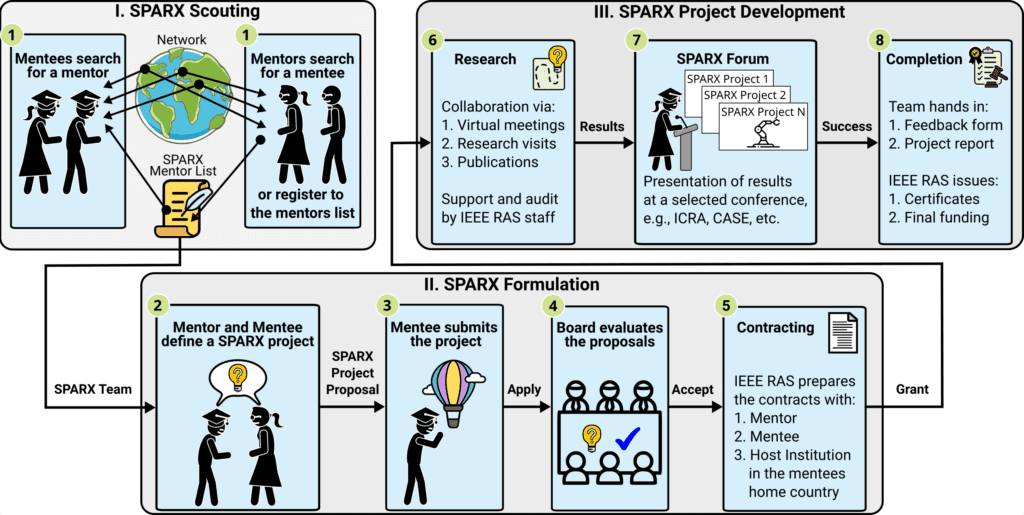
The SPARX program is organized into the following stages:

The SPARX Program Stages

  1. SPARX Scouting: In this stage, the SPARX team must be defined. The team selection should be based on aligning the mentee’s skills, experience, and research interests with the mentor’s objectives
    1. Mentees identify a mentor partner using the SPARX mentor list or by directly contacting a senior researcher within their professional network.
    2. Mentors register in the SPARX mentor list or directly contact a faculty member from their network to form a team.
  2. SPARX Formulation: In this stage, a project proposal should be prepared and submitted.
    1. SPARX Project Definition: The mentor and mentee define the SPARX project based on their shared research interests and expertise. They outline the objectives, topics, potential outcomes, and faculty engagement plan. (See the project proposal template).
    2. SPARX Project Application: The mentee submits the project proposal for evaluation via a SmartSheet form. The submission must include both the mentor’s and the mentee’s CVs. For 2026 cohort, the deadline is December 19th, 2025.
    3. SPARX Project Evaluation: The SPARX Board evaluates the proposals and determines the list of accepted projects.
    4. SPARX Contracting: Once projects are selected, a formal agreement is established. IEEE RAS prepares contracts with the mentor, mentee, and host institution in the mentee’s country.
  3. SPARX Project Development:
    1. Research Collaboration: The mentee engages in an international research collaboration under the mentor’s supervision. The team’s responsibilities include:
      1. Holding regular online meetings (at least once per month).
      2. Participating in the mentor’s research activities, including group meetings and seminars.
      3. Creating or becoming involved with a local IEEE RAS Student Chapter.
      4. Visiting the mentor’s laboratory (if possible) and joining lab meetings regularly.
      5. Co-authoring RAS conference or journal papers with the mentor based on the research conducted.
      6. Writing a paper as the lead author towards the end of the mentorship period.
      7. Attending an RAS conference to present the research work.
      8. Establishing collaborations with other researchers during RAS conferences.
    2. SPARX Forum: The IEEE RAS DEI Committee organizes a SPARX Forum at a selected IEEE RAS conference, where each mentee presents the outcomes of the research collaboration. Awards for the best teams are given during the forum.
    3. SPARX Project Completion: The collaboration concludes with the submission of a joint report and a feedback form. Successful participants receive IEEE RAS completion certificates and a final travel grant to present their work at a conference.

Eligibility Criteria:

  • Mentors must:
    • Be faculty members or senior researchers with experience in group and project management, as well as in academic writing and paper submission.
    • Be active IEEE RAS members.
    • Guaranteed to be employed at a university or research institution for the entire duration of the collaboration.
  • Mentees must:
    • Be faculty members or experienced postdoctoral researchers or similar/above.
    • Be affiliated with, and currently located at, a university or research institution in a country eligible for IEEE Electronic Membership (see IEEE eMembership Countries), or
    • Be recognized as scholars at risk. Applicants may already be part of the Scholars at Risk Network (see Scholars at Risk). In this case, applicants do not need to be affiliated with a university or research institution in their home country. However, they must submit a support letter from their host institution confirming their status as a scholar at risk, along with their CV.
    • guaranteed to be employed at a university or research institution for the entire duration of the collaboration.
  • Mentees should:
    • Have prior research experience in Robotics or Automation.
    • Not necessarily be IEEE RAS members at the time of application. However, they are expected to obtain membership if their application is accepted. SPARX funds may be used to cover the membership fee.

Application Process:

As outlined above, the application consists of three main steps:

  1. Mentees and mentors form a SPARX team and define a project.
  2. Mentees submit their project proposals. Application Form Link: https://app.smartsheet.com/b/form/add39833aa7e4975a9396fea59b1d48a
  3. The submitted proposals are evaluated, and the selected projects receive financial support.


Submission deadline Dec 19, 2025.

Results notified January 31, 2026.