Home » Computer & Robot Vision » Activities
Best Poster Award Recipient: Joohwan Seo <[email protected]>

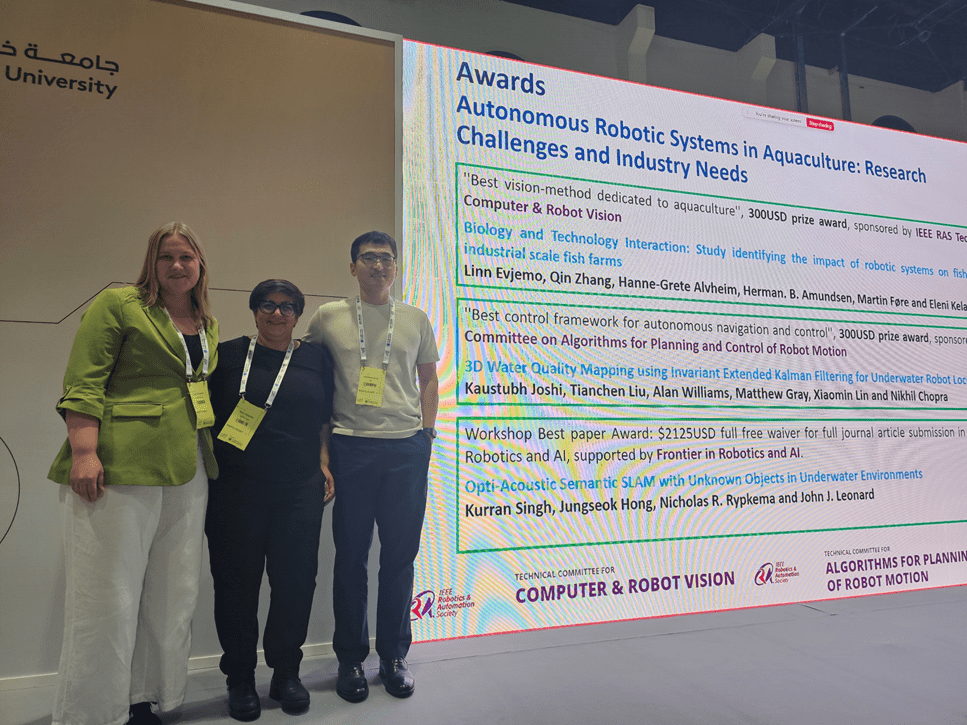
Workshop: Autonomous Robotic Systems in Aquaculture: Research Challenges and Industry Needs held held as part of the IEEE/RSJ International Conference on Intelligent Robots and Systems (IROS 2024)
”Best vision-method dedicated to aquaculture”
Biology and Technology Interaction: Study identifying the impact of robotic systems on fish behaviour change in industrial scale fish farms, Linn Evjemo, Qin Zhang, Hanne-Grete Alvheim, Herman. B. Amundsen, Martin Føre and Eleni Kelasidi
IEEE TC CRV Mentorship Lunch @ ICRA 2024 fro PhD and Postdoc wanted to obtain a faculty position in academia.
Name of award: WDO Best Abstract Award sponsored by the IEEE RAS Technical Committee Computer & Robot Vision.
Name of recipient(s):
Kaifeng Zhang (University of Illinois Urbana-Champaign) <[email protected]>
Baoyu Li (University of Illinois Urbana-Champaign) <[email protected]>
Kris Hauser (University of Illinois) <[email protected]>
Yunzhu Li (University of Illinois Urbana-Champaign) <[email protected]>
Winning abstract title: AdaptiGraph: Material-Adaptive Graph-Based Neural Dynamics for Robotic Manipulation
Award announcement on the workshop
Finalists
Award winner
For more infomation on workshops, visit this link.
At the workshop titled “Supervised Autonomy: How to Shape Human-Robot Interaction from the Body to the Brain,”organised during ICRA 2024 Federico Masiero, a postdoc at Heidelberg University, was awarded 1st prize for their poster contribution. Masiero’s work was awarded among 15 posters and 3 demonstrations presented during the workshop. The workshop explored the intersection of human cognition and perception robotics in HRI, aiming to enhance understanding and development in this field.
For more information on workshops, visit this link.
Faculty, students, and post-docs from the TC on Computer and Robot Vision and the TC on Model-Based Optimization for Robotics gathered together to discuss the faculty job search process.
Collaborative Multi-TC Mentoring Event at ICRA 2024
The field of robotics has witnessed unprecedented growth in the integration of machine learning models, especially with the recent advent of foundation models, neural-symbolic AI, generative models (large language models, diffusion models, etc), and other emerging learning models. These methods have revolutionized various tasks in computer vision, natural language processing, computer graphics, etc. However, their application in the context of robotics remains underexplored. This special issue (SI) is to fill this gap and bring together leading researchers and practitioners in robotics to shed light on the latest advancements, methodologies, and best practices in this interdisciplinary domain. This SI aims to provide a comprehensive overview of the current landscape, from the underlying theories and in-depth reviews to the forward-looking perspectives, practical implementation, and real-world challenges. By fostering a holistic understanding and promoting collaboration between experts, we aspire to accelerate the adoption of these advanced models and drive the next wave of innovations in robotic systems, including but not limited to robotic perception, cognition, planning, and control.
6 formal papers were selected and published.
Organizers: Lin Zhao, National University of Singapore; Chen Wang, TC co-chair
More information can be found here.
This workshop consists of a seminar and a challenge on robot learning and SLAM. We aim to present the latest results on the theory and practice of both traditional and modern techniques for robot learning, robot perception, and SLAM. A series of contributed and invited talks by academic leaders and renowned researchers will discuss ground-breaking perception and mapping methods for long-term autonomy based on current cutting-edge traditional solutions and modern learning methods. The workshop will also discuss the current challenges and future research directions and will include posters and spotlight talks to facilitate interaction between the speakers and the audience. We plan to have a hybrid format with in-person speakers/attendees and a live broadcast to convey the message to a broader audience. The workshop was successfully held with the number of participants surpassing the meeting room’s capacity! Additionally, over 3,000 viewers tuned in on YouTube in just three days!
Share this page