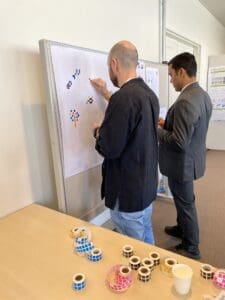
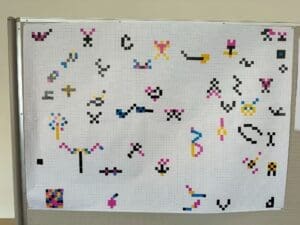
Participants received leaflets containing QR codes that directed them to a portal. This portal asked them to reflect on how they currently feel and how they would like to feel, generating two personalized prompts. Each participant was provided with a set of stickers to place on a communal board, following a set of simple swarm rules. For instance, one rule might specify that a participant only has a certain number of black stickers, and they must all be connected. While the swarm rules were consistent for everyone, the prompts were unique to each individual, resulting in the creation of an emergent piece of collective art.
Workshop participants creating an emergent piece of collective artTheir result
Major Publications (not counting Proceedings from above workshops): provide references for researchers seeking information on performance evaluation and benchmarking.
Quantifying Performance of Intelligent Systems,” International Journal of Intelligent Control and Systems Special Issue; Volume 16, Number 2, June 2011
Performance Evaluation and Benchmarking of Robotic and Automation Systems [TC Spotlight] Madhavan, R.; del Pobil, A.P.; Messina, E.; Robotics & Automation Magazine, IEEE, Volume: 17 , Issue: 1; Publication Year: 2010 , Page(s): 120 – 122.
Competitions
These put into action the benchmarks and performance evaluation methods. By organizing and promoting competitions, we put into practice what is discussed during workshops and in publications. Competitions validate the approaches proposed and expose members of the community (especially students) to the concepts. Some of the metrics and test methods are being advanced into draft standards (e.g. the 6DOF localization from the Perception Challenge formed the technical foundation for an ASTM standard being balloted under E57 Committee on 3D Imaging Systems).
ICRA’12 Mobile Microrobotics Challenge (MMC) Minneapolis, USA
ICRA’12 Solutions in Perception Challenge (SPC) Minneapolis, USA
ICRA’12 Virtual Manufacturing Automation Challenge (VMAC) Minneapolis, USA
ICRA’11Mobile Microrobotics Challenge (MMC) May 12, 2011 – Shanghai, China
ICRA’11Solutions in Perception Challenge (SPC) May 11, 2011 – Shanghai, China
ICRA’11 Modular and Reconfigurable Robot Challenge (MRRC) May 10, 2011 – Shanghai, China
ICRA’11 Virtual Manufacturing Automation Challenge (VMAC) May 10, 2011 – Shanghai, China
List of outreach activities outside the RAS
The TC has coorganized events with Euron and workshops at RSS. Other initiatives have been carried out in collaboration with the RoboCup organization and in conjunction with the US Department of Homeland Security (DHS). The RoboCup Rescue International competitions rely on quantifiable measures of robot performance within draft and existing test methods for evaluating their ability to assist in disaster response. The best-performing robot teams are invited to participate in the NIST-DHS Response Robot Evaluation Exercises, typically held every 18 months at Disaster City, a major responder training facility in the United States.