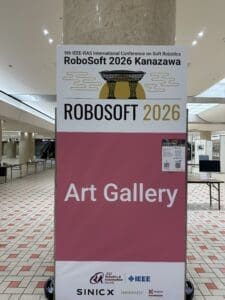
It has been a few weeks since RoboSoft 2026, but we are still reminiscing on a great conference filled with innovation and events such as this year’s Art Gallery. We had the amazing opportunity to chat down with a few of the artists who brought these soft robotic masterpieces to life.
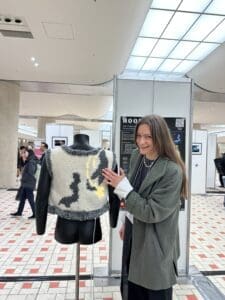
“Hooked” with Juliette Hars
Q1. What inspired this work?
In my free time, I do a lot of crochet and knitting, which are fiber arts that you do by hand. And this is why I was thinking of making this garment, that basically is a capacitive sensor.
Q2. What makes your work unique or different?
So when you touch it, it responds to touch and pressure and the more you press, the brighter are the LEDs on the gilet. So that’s why I thought of making this.
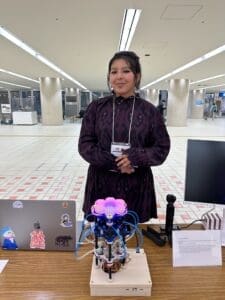
“To Touch a Story” with Carolina Silva-Plata
Q1. What makes your work unique or different?
Well, I think this can be different because it’s a soft body expressing text. And maybe next we can send some message in real time and it can express.
Q2. What does presenting it at IEEE RoboSoft mean to you?
I’m so happy to be here. This is my first time. This is the first time I travel so far away. And I’m so happy for that. This really makes me see a new world, I mean, in the academic way.
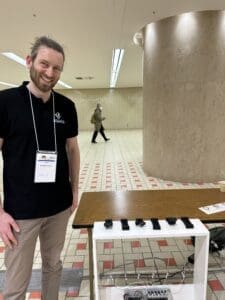
“Claviiiiiier” with Felix Vanneste
Q1. What inspired this work?
I’m a doctor in the simulation of soft robots. And after my PhD, I wanted to try new things. And so I’ve done a postdoc in an art school, working with an artist. And because I play with the flexibility of the matter, I play with movements. And here the idea was to create different movements as well as different rhythms and to combine the two together.
Q2. What makes your work unique or different?
It is a really interesting way to use 3D printing because here, if you can see closer, we have the same geometry. But the infill is different. And so each note is a different movement. And it’s due to the internal geometry, which is, I think, interesting and novel.