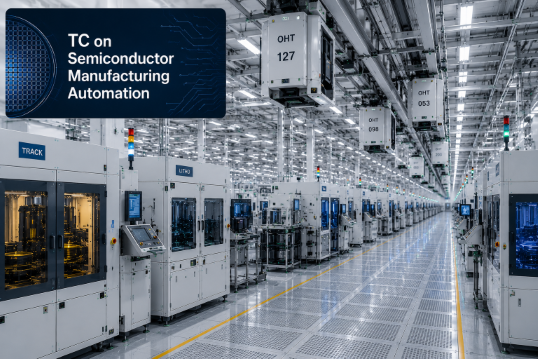
Semiconductor manufacturing is widely recognized as one of the most complex and capital-intensive manufacturing environments. This complexity arises from tightly constrained and highly interconnected processes, reentrant production flows, extremely expensive and sophisticated equipment, rapid technology scaling, volatile demand, and pervasive automation that generates massive volumes of heterogeneous data. Despite these challenges, the semiconductor industry remains a strategic backbone of the global economy and a critical enabler for industries such as AI, mobility, energy, and advanced electronics. With the evolution toward highly automated and data-rich wafer fabrication facilities (fabs), the scope of automation is rapidly expanding beyond traditional equipment-level control. Modern semiconductor manufacturing increasingly integrates advanced decision intelligence, including operations research, artificial intelligence, reinforcement learning, digital twins, and stochastic modeling, to enable predictive, adaptive, and autonomous decision-making across equipment, factory, and supply-chain levels. This shift is driving the emergence of intelligent and autonomous fabs capable of real-time optimization under uncertainty, improved resilience, and sustainable high-performance operation.
- Intelligent and Autonomous Control
- Advanced Process Control (APC) and Run-to-Run Control
- Reinforcement Learning and Adaptive Control for Process Automation
- Virtual Metrology (VM) and Automated Virtual Metrology (AVM)
- Self-Optimizing Control Systems and Autonomous Control Loops
- AI-Driven Manufacturing Systems
- Agentic AI and Multi-Agent Coordination
- Machine Learning for Planning, Scheduling, and Coordination
- Deep Learning for Pattern Recognition and Anomaly Detection
- Causal AI for Decision-Making under Uncertainty
- Autonomous Decision Support and Recommendation Systems
- Scheduling and Operational Optimization
- Fab-Wide Planning, Scheduling, and Dispatching Algorithms
- Cluster Tool Scheduling and Real-Time Resource Allocation
- Intelligent Wafer Release and Dispatch Policies
- Predictive Maintenance and Maintenance Policy Optimization
- Integrated Equipment- and Fab-Level Utilization Optimization
- Equipment and Factory Design Engineering
- Equipment Modeling, Calibration, and Digital Twins
- AI-Augmented Design for Automation and Mechatronics
- Design for Manufacturing (DFM) with Embedded Intelligence
- Data-Centric Engineering and Design Chain Optimization
- Factory Modeling, Simulation, and Evaluation
- Factory Digital Twins and Hybrid Simulation Platforms
- High-Fidelity Simulation for Throughput, Yield, and Risk Evaluation
- Physics-Informed Simulation with Machine Learning Acceleration
- Benchmark Problems and Industrial Case Studies Using Real Data
- Data Analytics and Predictive Intelligence
- Big Data Analytics and Representation Learning
- Predictive Quality and Yield Forecasting
- Time-Series Modeling for Process and Equipment Behavior
- Uncertainty Quantification and Reliability Prediction
- Explainable AI and Trustworthy Manufacturing Intelligence
- Smart Material Handling and Connectivity
- Automated Material Handling Systems (AMHS) with Autonomous Mobile Robots
- Wireless Manufacturing Systems with IoT and RFID Integration
- Real-Time Localization, Navigation, and Scheduling of AMRs
- 300 mm and Future Node Logistics Automation (e.g., 450 mm Concepts)
- Supply Chain and Sustainable Manufacturing
- Semiconductor Supply Chain Modeling and Digital Coordination
- Eco-Efficient and Low-Carbon Semiconductor Manufacturing
- Energy-Aware Fab Operation and Resource Sustainability
- Closed-Loop Lifecycle Optimization (Fab → Supply Chain → Product Reuse)