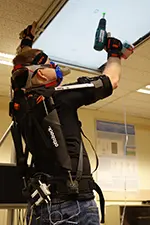
Wearable robots have the potential to improve our lives in countless ways. People with weakened limbs can use exoskeletons to augment their strength or to retrain lost motor abilities, thus allowing them to nonetheless successfully perform activities of daily living. Similarly, workers of the future could use wearable robots to manipulate bigger and heavier loads, avoid injuries, and receive augmented feedback to enhance performance. Finally, wearable robots could even be used in sports, allowing wearers to move faster and farther.
Unfortunately, despite extensive research in this area, most wearable robots remain limited to controlled laboratory conditions. This is due to several reasons: insufficiently robust mechanical design and control, excessive weight or power consumption, insufficient evaluations with human subjects, unclear cost-effectiveness and other issues. However, these barriers are not insurmountable, and there are many opportunities for innovative solutions from research groups worldwide.
This special issue aims to bring wearable robots closer to broad real-world adoption by highlighting the latest innovations in the development of robust, intelligent wearable robots and their evaluations in real-world scenarios. It will focus on papers about working systems that are ideally evaluated with human subjects in order to determine the technology’s practical potential and impact on people with disabilities, workers, sportsmen, and others. Papers on stationary wearable robots will not be considered, though papers may be accepted if they describe the transfer of knowledge from stationary to wearable robotic technologies.