Home » Publications » ToH » 20 Years of World Haptics
At the IEEE World Haptics Conference (WHC) in Suwon, Korea from July 8-11 2025, a special session celebrated the 20th anniversary of the first World Haptics Conference held in Pisa, Italy in 2005. The session was organized by Ed Colgate, Lynette Jones and Hong Tan at the request of the WHC 2025 co-chairs, Seungmoon Choi and Ki-Uk Kyung, who considered it important to acknowledge this significant milestone for the haptics community.
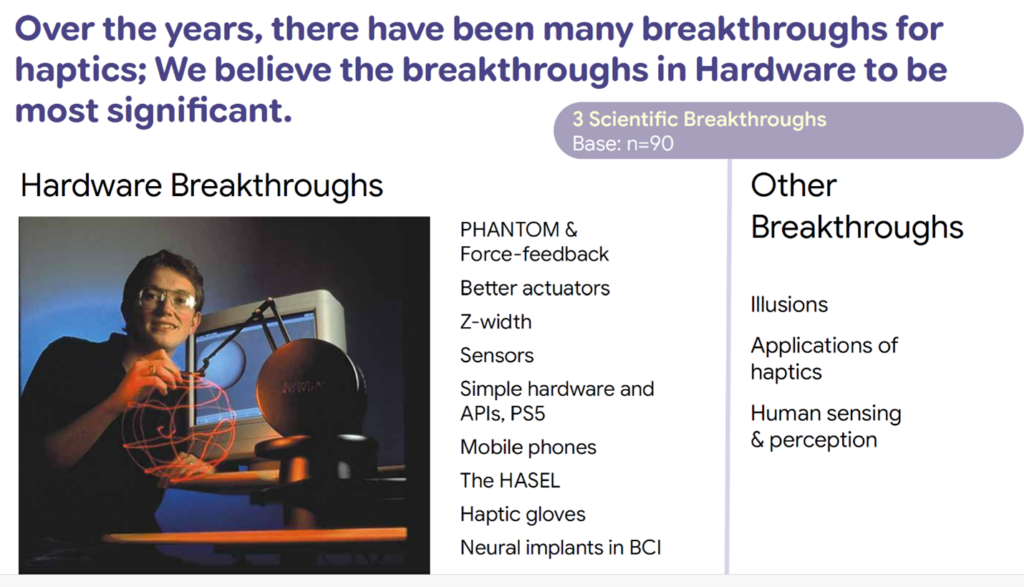
Fig. 1. Responses to the question: What are the three key scientific/engineering breakthroughs in haptics?
In preparing for the special session, we thought it was important to reach out to the haptics community to get its perspectives on past achievements, challenges and future directions. A survey was developed comprising 15 questions that covered areas such as the types of communities we work in or collaborate with, the accomplishments and progress that have been made in haptics research and technology over the past 20 years, and future opportunities for haptics. The survey was sent out to members of the haptics community and responses were received from 121 respondents. The survey results were analyzed by Jessie Sims, a user experience researcher at Google, and presented by her at the WHC. The findings are summarized in the following document that was presented at the conference.
Survey respondents overwhelmingly indicated (93%) that the IEEE Transactions of Haptics is the most important journal for publishing and reading about haptics research and that the IEEE World Haptics Conference is the most important conference (92%) for publishing and presenting work, and for learning about the latest haptics research. In terms of future conferences, the survey respondents identified three major areas that they would like to hear more about: affective touch, multimodal interaction, and AI integration. It was interesting to learn that the research experiences of approximately half (50.2%) of the respondents have included participation in developing and/or evaluating consumer products or industrial applications of haptics, most frequently related to electronics and robotics. In looking to the future of haptics, there were five key scientific and technological challenges identified by respondents: (1) the cost, size, and limited capabilities of existing actuators used in haptic devices; (2) the size, volume and form factor of many devices developed that have limited their range of applications; (3) the lack of standardization in terms of hardware/IC tiering, APIs that allow hardware and platform-independent specification of signal parameters, and design tools that support the creation of rich and expressive haptic signals that are designed once and played everywhere; (4) the need for high-fidelity/realistic feedback in domains such as VR/AR, and (5) the importance of understanding and evaluating the added value provided by haptic feedback systems. Finally, in looking to the past and the accomplishments made by the community, respondents identified a number of significant breakthroughs in hardware from the development of the Phantom and other force-feedback devices to haptic gloves that have had a critical impact on advancing the field. The breakthroughs in hardware that respondents identified as being most significant are shown in Fig. 1.
To complement the results from the survey, 10 members of the haptics community were interviewed prior to the conference. They came from different areas of haptics representing the breadth of haptics research and also varied in terms of their years of experience in the field. Fig. 2 shows the interviewees who were asked the following questions:
Fig. 2. Interviewees
The key scientific and engineering breakthroughs identified by the interviewees ranged from advances in our understanding of the neurophysiology of the pathways involved in communicating tactile information from the skin to the brain including the development of tools for modelling the contact mechanics of hand-object interactions, to the significant impact of commercially available devices and haptics toolkits that opened the field to many more researchers. Several interviewees noted the substantial benefits derived from the inclusion of haptic effects in consumer products, such as phones and watches, and in automobiles, that have helped the general public understand how the sense of touch can be used as a tool for communication. Smart phones and watches together with gaming controllers were considered to be the products that haptics has had the most impact on. The inclusion of haptic effects in medical and surgical simulators and more recently in teleoperated surgical robots was also noted as an important application of haptics. The seminal contributions of the late Vincent Hayward to our field, from illuminating the role of haptic illusions to elucidating the links between engineering, physiology and psychology, were especially noted.
The interviewees reflected a profound sense of optimism about the future of haptics, given its strong inter-disciplinary approach to research and the collaborative environment in which much of this research is conducted. A number of areas were identified as providing opportunities for advancement, including affective haptics, human-robot interactions, particularly in the context of teleoperation, and surface and mid-air haptics. It was also thought that the future of haptics would benefit from advancements in AI and ML and from the promise of smart materials and new actuator technologies. There will be challenges associated with some of these research directions due to the complexity of the sense of touch, the bandwidth required for effective communication, and the dynamic range required to present realistic feedback. Several interviewees commented on the tradeoffs that have to be made in creating haptic devices for specific applications and at the same time the need for versatile devices that can be used in a variety of settings.
Several areas of advancement were identified in response to the question regarding what is most needed for significant developments in the field. These ranged from fundamental scientific investigations that result in the generation of neurophysiological and perceptual models that characterize more fully how humans perceive mechanical stimuli, to the importance of creating new classes of actuators and sensors that can be miniaturized and potentially microfabricated. One outcome from the development of better perceptual models would be to provide insight as to what haptic feedback is needed to perform a specific task. Establishing metrics for quantifying the value of haptics in different applications was also noted as being an important goal.
The haptics community is relatively small and there are often discussions at conferences about growing our community. When asked how we could achieve this and increase the visibility of haptics, interviewees proposed strategies such as making more extensive use of social media so that a broader section of society including school children become more familiar with the field. It was also suggested that haptics researchers could engage more with larger conferences in related fields (robotics, HCI, neuroscience) so that scientists and engineers working in academia and industry in those areas become more familiar with haptics research. Comments were made regarding the uniqueness of the haptics community with its strong inter-disciplinary base and that although it is desirable for the community to attract people working in related fields and so increase its size, there are benefits in being small and focused.
The final question posed to interviewees asked what advice they would give to newcomers entering the field today. Many interviewees acknowledged the importance of acquiring a solid foundation in a number of areas related to haptics including mechanical design, human-computer interaction, perception, and electrical and mechanical engineering and to study and read about what has been done previously. While this may seem daunting, it was also stressed that it was important to “roll up your sleeves” and get involved in designing, building and experimenting with physical systems. These can be shown to peers and colleagues who provide useful feedback that is critical to the learning process.
The above is a summary of the responses of the interviewees to the various questions. Below are the full interview videos:

| Hiroyuki Shinoda | Allison Okamura | Kenneth Salisbury |
| Marcie O’Malley | Matteo Bianchi | Pedro Lopes |
| Roberta Klatzky | Antonio Bicchi | Cagatay Basdogan |
| Hasti Seifi |
and provide much more information about the perspectives of the different interviewees. Their thoughtful responses to the questions demonstrate both the strength of the haptics community and its future potential.
The final part of the special session was a panel discussion that built upon the results from the survey and in-depth video interviews. Some of the responses of the interviewees described in the previous section were included in the panel session. Ed Colgate moderated the discussion with five panelists: Lynette Jones, Karon MacLean, Jee-Hwan Ryu, Craig Shultz, and Michaël Wiertlewski. Brief video clips from the interviews were presented prior to posing each of the following questions.
Fig. 3. Panel discussion with (left to right) Jee-Hwan Ryu, Michaël Wiertlewski, Karon MacLean, Craig Shultz and Lynette Jones.
In response to the first question regarding key scientific or engineering breakthroughs over the past twenty years, the impact of commercially available haptic devices such as the Phantom and of open-source electronic prototyping platforms such as Arduino were highlighted as critical to opening up the field of haptics research in what could be described as a democratization process. The incorporation of tactile signals in consumer products such as phones and watches also contributed to expanding the community by providing “haptics at scale.” The areas identified as benefitting from haptics included medical and surgical simulation, rehabilitation and prosthetic devices and affective feedback systems.
Looking at the future, the key needs identified by the panel echoed those suggested by several of the interviewees, namely: finding “the killer app” that could speed up research and demonstrate the value of haptics; developing models of the cognitive systems involved in decoding and processing tactile information so that these could be used to inform the design of devices; and identification of the core elements of haptics (equivalent to the RGB color model) which may prove to be transformative to the field both scientifically and in terms of device design. Related to this question, panelists were asked about the grand challenges to which the field should dedicate itself. The need for a generalized and reconfigurable haptic display that can be applied in multiple use cases was identified as a significant challenge. The importance of understanding and simulating physical interactions was also considered an area that haptics researchers can make a major contribution to, particularly in the context of robots that require tactile intelligence to interact with the physical world (e.g., during dexterous manipulation) and for Generative AI technology. In response to the question regarding what excited the panel about the future of haptics, the range of disciplines in the field and its openness were identified as core sources of excitement. The challenge associated with creating total-body prostheses, with a robot becoming part of the human both in terms of interacting with the environment and making social connections, were also considered an exciting future endeavor.
The video of the special session, including the presentation of the survey results and the panel discussion, can be found to the right:
The celebration of two decades of World Haptics Conferences included a survey, interviews and a panel discussion. Each of these activities enabled us to see the different experiences and perspectives that have shaped our field. There was also remarkable consistency in the responses to some of the questions that highlighted past accomplishments and future challenges. The need to develop more sophisticated tactile communication systems for consumer products that go beyond the delivery of simple vibrations was identified as one of the key challenges. The importance of having a better understanding of human sensorimotor capabilities so that haptic effects can be more successfully implemented in a range of applications from VR to motor skill learning was also highlighted as an important future research direction. Finally, as was also noted by many of the survey respondents, the highly interdisciplinary nature of the haptics field provides an opportunity for growth and impact that we should seek to exploit in the years ahead.
Share this page